
Notice About AAC Services
Please note that Dr. Gilbert is no longer with the Center for Excellence in Disabilities (CED), and at this time, we are unable to provide AAC consultation services. We are actively working to fill this position and look forward to resuming AAC consultations in the near future.
In the meantime, AAC evaluations and consultations are available through two local providers in Morgantown:
- Chatter & Chalk, Dr. Gilbert’s private practice
- WVU Speech, Language and Hearing Clinic, which offers a range of speech-language services, including AAC support
Feel free to contact either provider directly for support based on your needs.
If you’ve already received an AAC recommendation and are currently working with a speech-language pathologist, you may also be eligible to borrow a device through the Assistive Technology Loan Library offered by the WVATS program. For more information, please visit: wvats.cedwvu.org.
The Communication Access and Assistive Technology (CAAT) Clinic provides consultation, training and resources for individuals who have difficulty being understood using speech. Professionals working in the clinic will work collaboratively with clients, their families and other support professionals to identify areas of need to improve communication. We provide services to individuals of any age with a range of disabilities.
The CAAT Clinic offers:
-
Augmentative and Alternative Communication (AAC) Consultations
Consultations are offered in-person at the WVU CED or virtually using video conferencing (Zoom). During consultations, the speech-language pathologist will review a history of the client’s communication, complete questionnaires and observe the client during a preferred activity or routine. By the end of the visit, the client and their caregivers will receive recommendations for next steps and resources to improve their access to communication with consideration of all barriers. Following the consultation, families will receive a summary report. 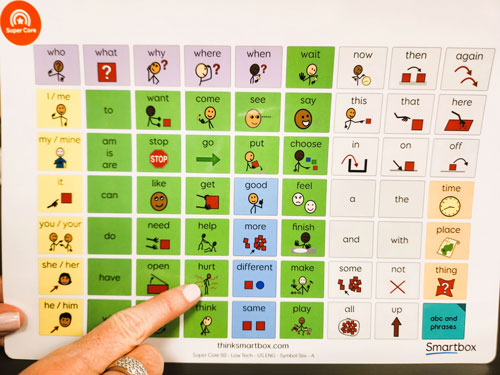
-
Support Services
- AAC communication partner training
- AAC system and vocabulary technical assistance (troubleshooting)
- Workshops, trainings and webinars (based on requested need)
What is AAC?
“Augment” means to add to someone’s speech and “alternative” refers to a modality other than speech. For approximately 4 million children and adults in the United States alone, augmentative and alternative communication (AAC) strategies, tools and technologies provide access to self-determination, learning and development, education, personal care, social engagement, and employment (Beukelman & Light, 2020).
There are two components to the definition of AAC:
- Any way a person communicates using additional tools and strategies outside of spoken words, and
- Having that message successfully understood by a communication partner.
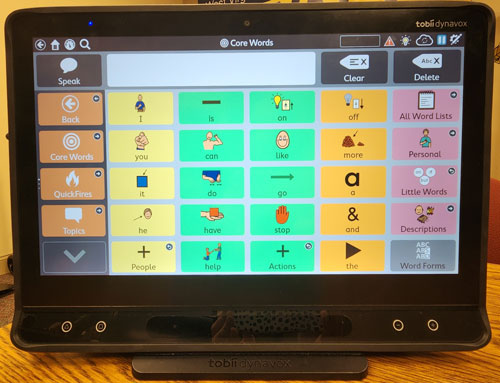
There are two major types of AAC: unaided and aided. Unaided forms of AAC do not require equipment or technology such as vocalizations, approximations of speech, body movements or eye blinks. Unaided forms of AAC are also referred to as “no-tech” options. Aided AAC options include the use of low-technology, mid-technology and high-technology tools and systems. A communication board or picture exchange system are examples of low-tech AAC, while computer-based speech generating devices and tablets would represent high-tech AAC. Aided AAC systems have visual representations of vocabulary (i.e., words) such as physical objects, photographs of real objects, picture symbols or written words. Figure 1 demonstrates picture symbols that represent high-tech, mid-tech and low-tech AAC options.
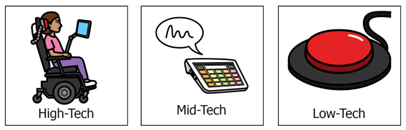
Figure 1
Who Uses AAC?
There are no “typical” AAC users. Thus, users can represent all abilities, age groups, sexual orientations, genders, socioeconomic status and ethnic and racial backgrounds. Some AAC user diagnoses include, but are not limited to:
Children & Adolescents:
- Angelman’s syndrome
- Apraxia of speech (AOS)
- Autism Spectrum Disorders (ASD)
- Cerebral Palsy
- Developmental disabilities
- Down syndrome
- Fragile X syndrome
- Rett syndrome
- Specific Language Impairment (SLI)
- Traumatic brain injury (TBI)
Adults:
- Alzheimer’s disease
- Amyotrophic lateral sclerosis (ALS)/Motor Neuron Disease
- Aphasia (stroke patients)
- Dementia
- Disabilities from childhood/adolescence transitioning to adulthood
- Huntington’s disease
- Parkinson’s disease
- Traumatic brain injury (TBI)
Meet Our Team
Douglas Cumpston, MBA, ATP
Assistive Technology Professional, WVATS
douglas.cumpston@hsc.wvu.edu
Resources

References
- Beukelman DR, Light JC. Augmentative & Alternative Communication: Supporting Children and Adults with Complex Communication Needs. Paul H. Brookes Publishing Co; 2020.
- Augmentative and alternative communication (AAC). American Speech-Language-Hearing Association. Accessed December 4, 2023. https://www.asha.org/public/speech/disorders/aac/#about.
- Burkhart LJ. What is AAC? ISAAC. Accessed December 7, 2023. https://isaac-online.org/english/what-is-aac/.