Protect Disability Network Digital Toolkit
What’s at Stake: Facts on Proposed Funding Cuts and How to Talk About Them
The U.S. President's proposed budget would eliminate funding for programs listed below that support individuals with disabilities.
These funds are essential for providing critical services to West Virginians with disabilities. Without this funding, many of these services will no longer be available.
| Eliminated from National Budget | Associated WV Programs |
|---|---|
| University Centers for Excellence in Developmental Disabilities (UCEDDs) WVU Center for Excellence in Disabilities (CED) | WVU Center for Excellence in Disabilities (CED) |
| National Institute of Disability, Independent Living and Rehabilitation Research (NIDLRR) | |
| Developmental Disabilities Protection and Advocacy | Disability Rights of West Virginia |
| Leadership and Education in Neurodevelopmental Disability (LENDs) | WV LEND |
| Primary Care Training and Enhancement | WV Primary Care Training grant through the WVU CED that is training medical providers and students to better serve patients with disabilities and patients who have English as a second language (ESL). |
What would happen if the WVU CED and other UCEDDs were defunded?
- Not having the WVU CED funding would completely remove all services provided by the Center as they are free to families and providers (through training and technical assistance) because of the grant funding.
- More than $10 million in additional money leveraged by the Center because of its funding would be lost as well.
What can you do?
Calls and letters to congress
Congressional staff keep track of the number of calls and emails they receive asking the representative to oppose or support issues. You can call or email your members of Congress and senators using the sample letter and script in this digital toolkit.
-
It’s great to see that the U.S. President’s budget includes funding for some important disability programs, like the Developmental Disabilities (DD) Council. This shows a commitment to helping people with disabilities live more independent lives and be part of their communities.
But while this is a good step, cutting other important programs makes it harder for people with disabilities to get the full range of services they need. These programs aren’t just part of Diversity, Equity, and Inclusion (DEI) efforts—they are separate and necessary supports that help people with disabilities live well and take part fully in society.
Bringing back and keeping these programs will give people with disabilities better access to resources and more chances to succeed, especially here in West Virginia.
UCEDD Key Facts:
- What is a UCEDD? (plain language) There is at least one University Center in every state that supports people with disabilities through education, research and service.
- There are 62 University Centers for Excellence in Developmental Disabilities (UCEDDs) in the U.S. West Virginia has one – the WVU CED.
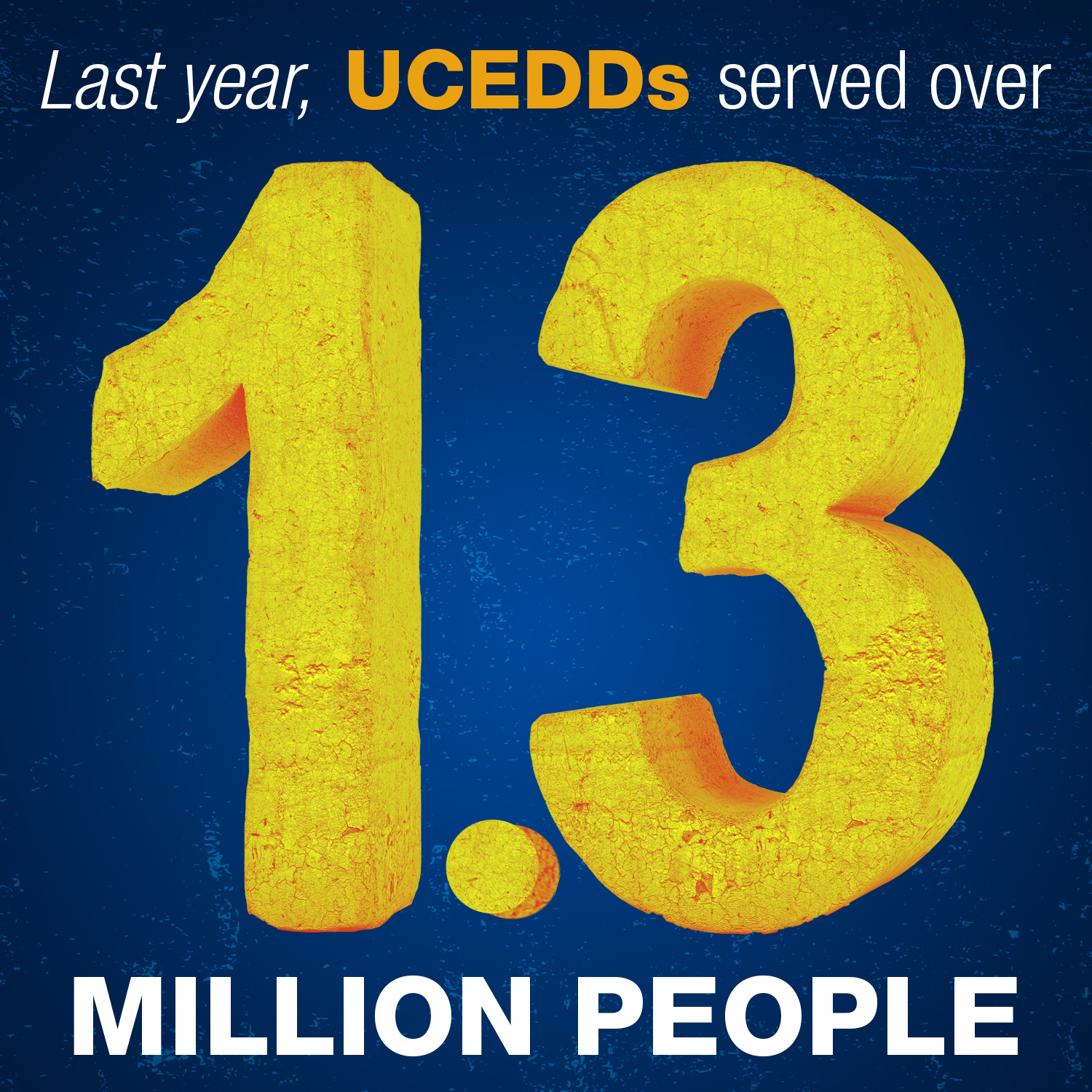
- As a network, the UCEDDs provide specialized, much needed services to millions of people helping them live well with their disability – last year alone these sites served well over 1.3 million individuals – that is nearly 20,000 people per Center.
WVU CED Key Facts:
- 37% (1 in 3) adults in West Virginia are living with a disability (according to the CDC).
- 21% of the state’s population are aged 65 and older, many of whom are at risk of developing new or increasing care needs.
- 80% of our counties (44 out of 55) have full or partial designation as health professional shortage areas. LEND programs prepare the healthcare workforce to improve the health of infants, children and adolescents with disabilities.
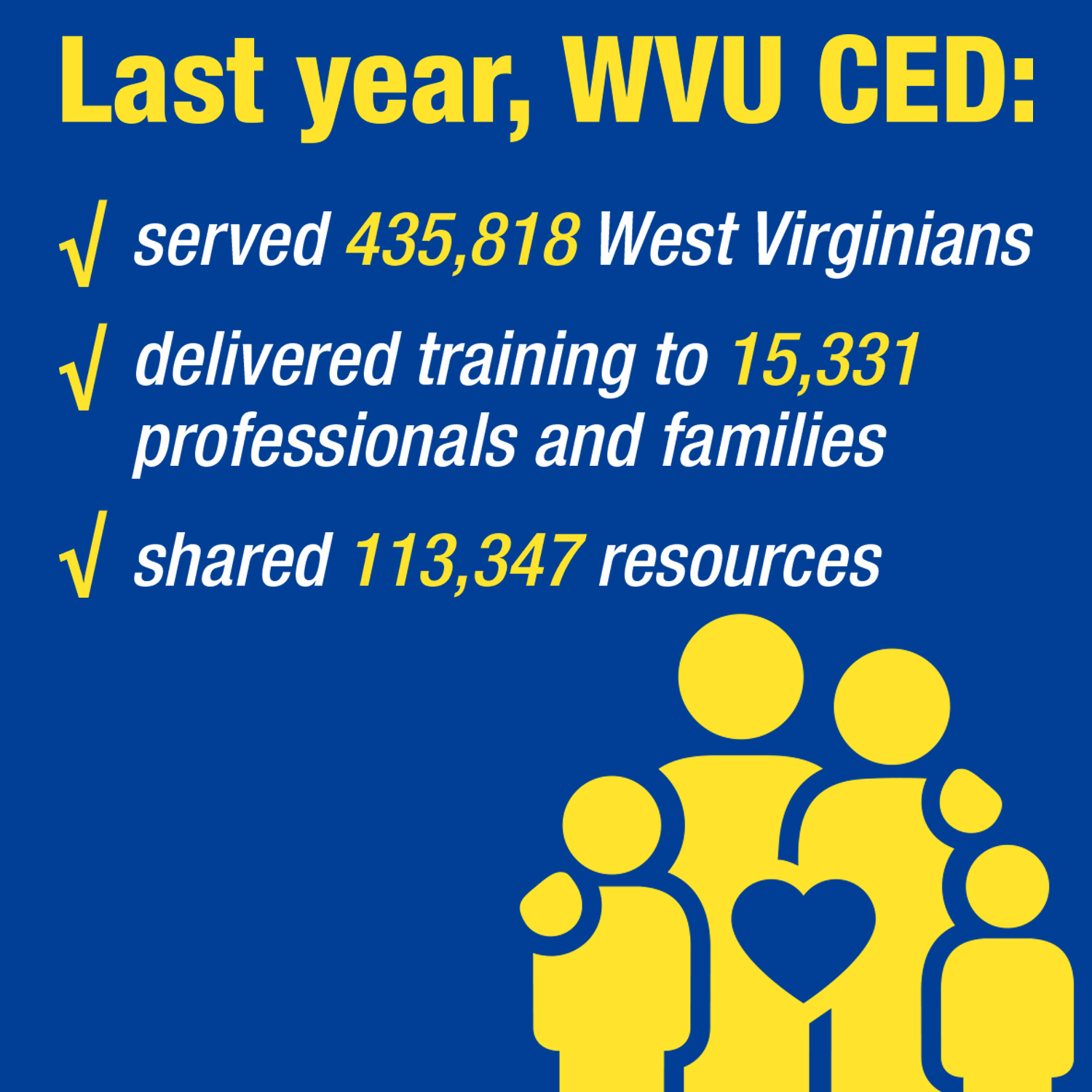
- WVU CED impact last year:
- 435,818 people received services
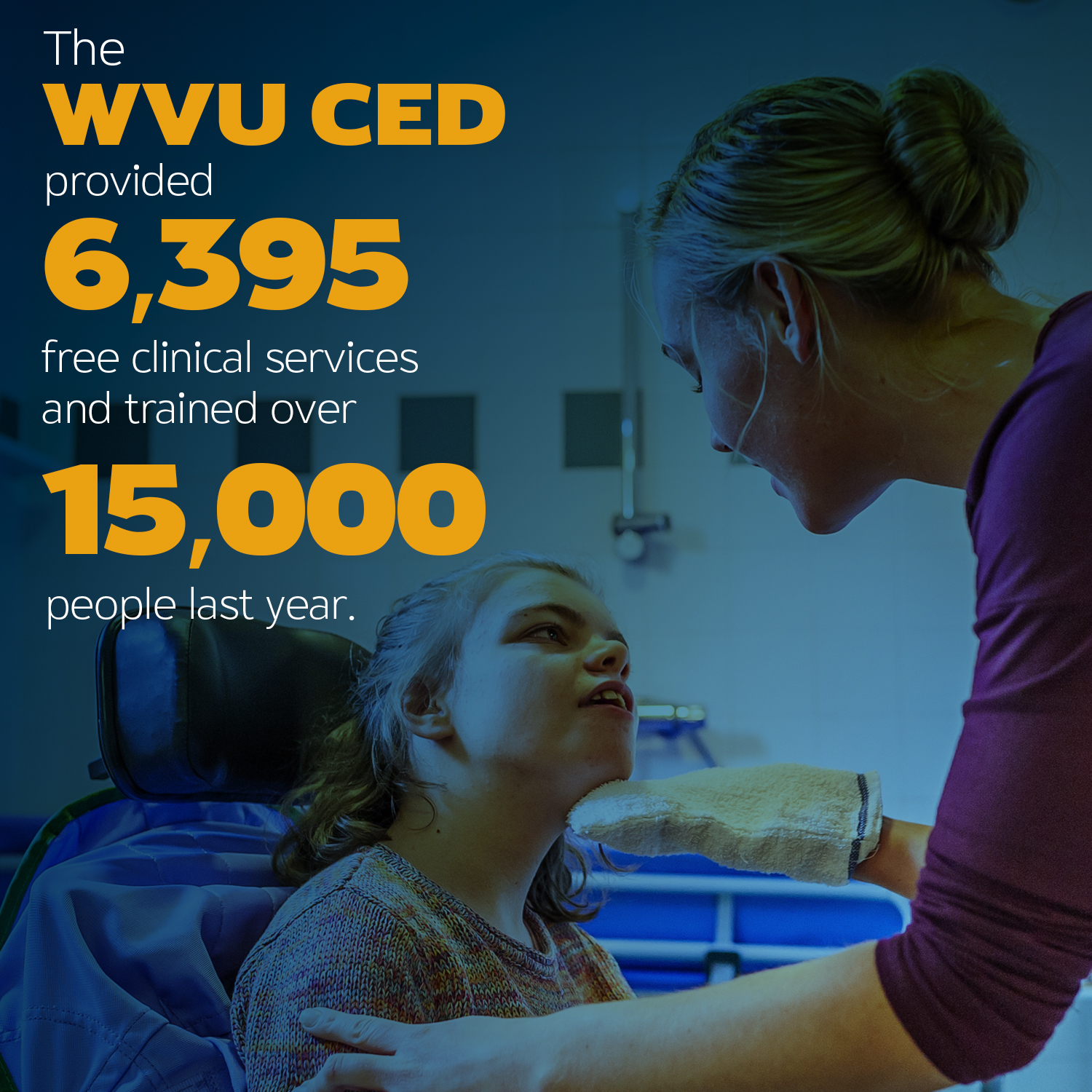
- 6,395 people received clinical services
- 15,331 people trained
- 61 research activities
- 113,347 disability related resources were disseminated
-
-
Sample Save UCEDDs Script for CED Staff
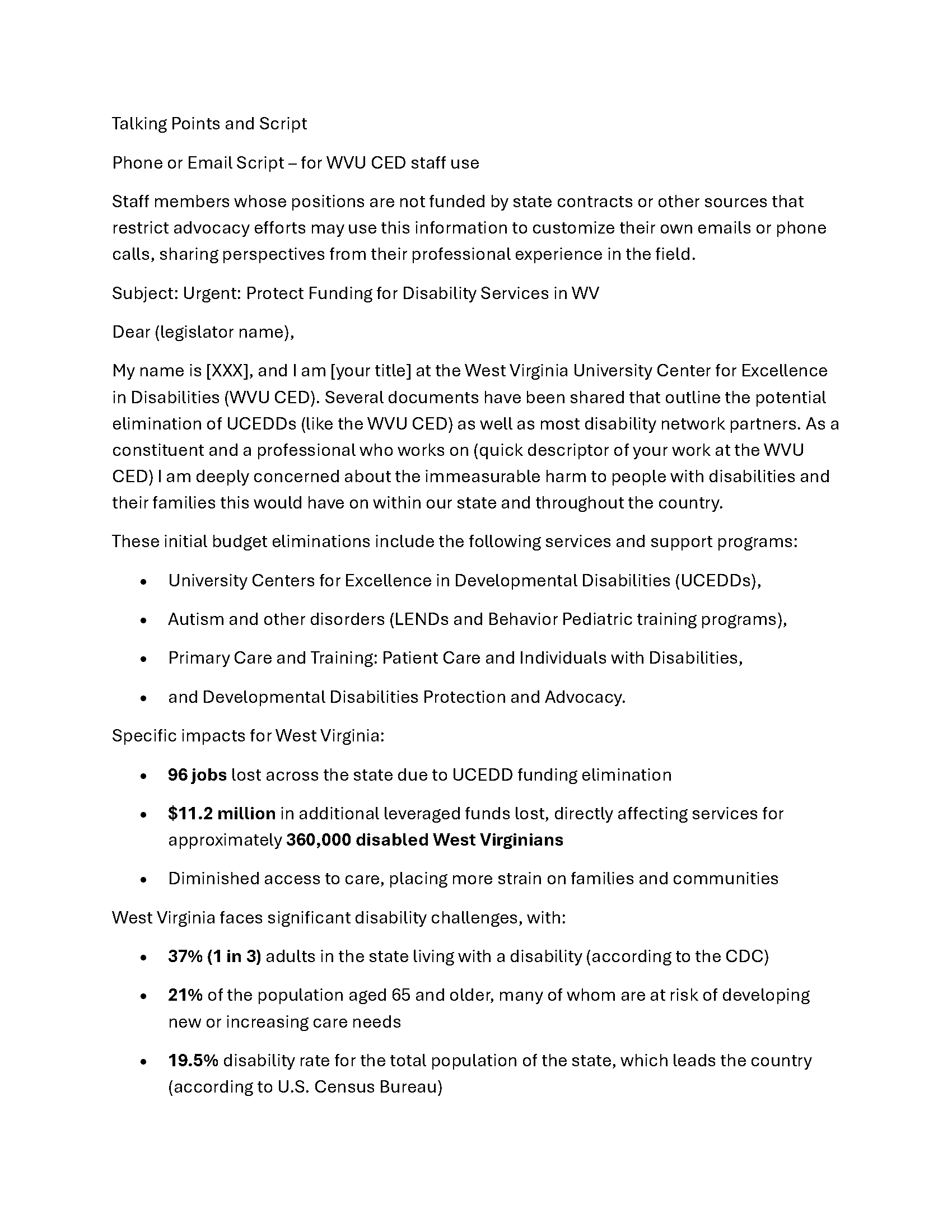
Download a Word Document of this Script Download a PDF of this scriptStaff members whose positions are not funded by state contracts or other sources that restrict advocacy efforts may use this information to customize their own emails or phone calls, sharing perspectives from their professional experience in the field.
Subject: Urgent: Protect Funding for Disability Services in WV
Dear (legislator name),
My name is [XXX], and I am [your title] at the West Virginia University Center for Excellence in Disabilities (WVU CED). Several documents have been shared that outline the potential elimination of UCEDDs (like the WVU CED) as well as most disability network partners. As a constituent and a professional who works on (quick descriptor of your work at the WVU CED) I am deeply concerned about the immeasurable harm to people with disabilities and their families this would have on within our state and throughout the country.
These initial budget eliminations include the following services and support programs:
- University Centers for Excellence in Developmental Disabilities (UCEDDs),
- Autism and other disorders (LENDs and Behavior Pediatric training programs),
- Primary Care and Training: Patient Care and Individuals with Disabilities,
- and Developmental Disabilities Protection and Advocacy.
Specific impacts for West Virginia:
- 96 jobs lost across the state due to UCEDD funding elimination
- $11.2 million in additional leveraged funds lost, directly affecting services for approximately 360,000 disabled West Virginians
- Diminished access to care, placing more strain on families and communities
West Virginia faces significant disability challenges, with:
- 37% (1 in 3) adults in the state living with a disability (according to the CDC)
- 21% of the population aged 65 and older, many of whom are at risk of developing new or increasing care needs
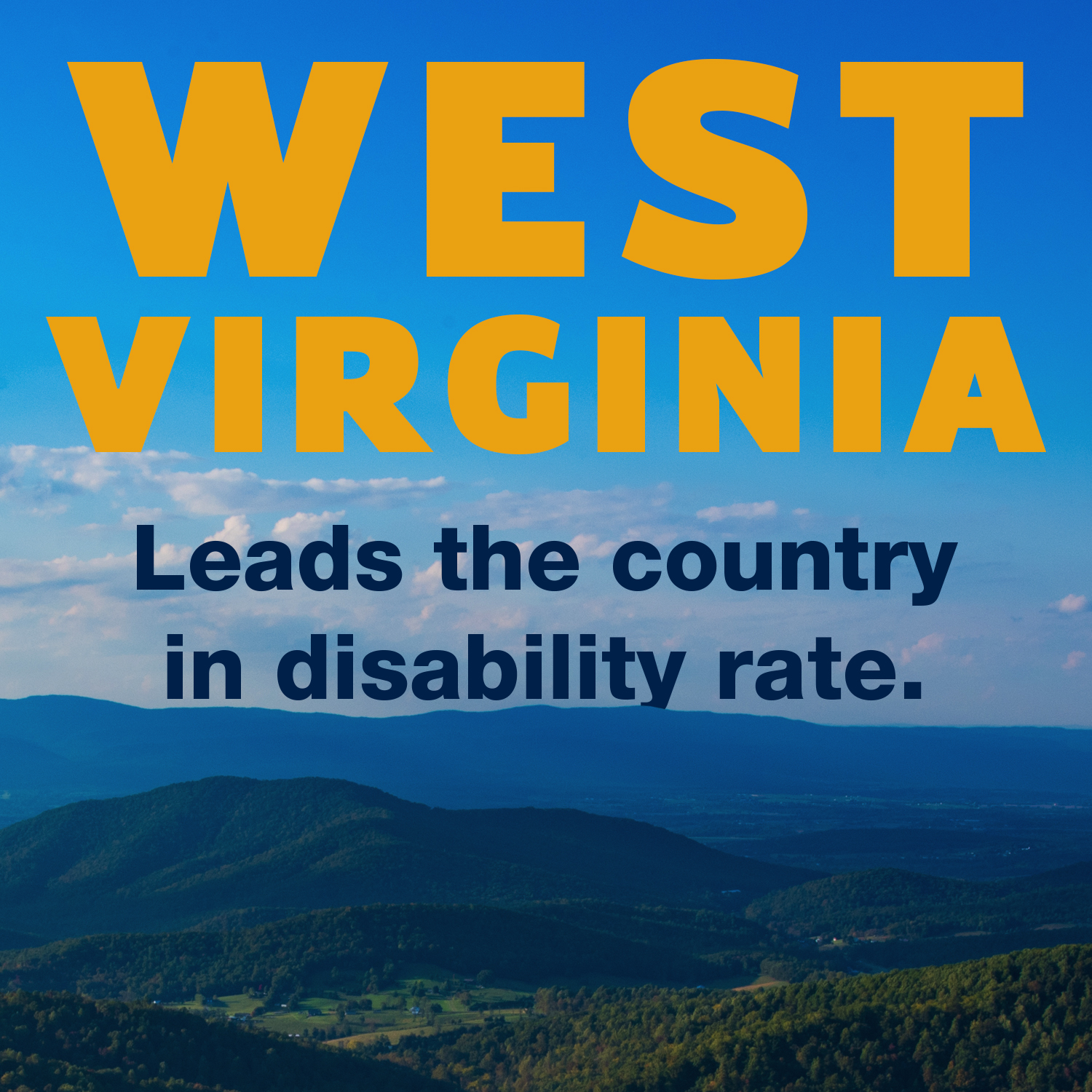
- 19.5% disability rate for the total population of the state, which leads the country (according to U.S. Census Bureau)
- The WVU CED serves individuals of all ages, including aging adults with disabilities, by providing critical programs that support their needs.
The national Developmental Disability Network is made up of three partners: University Centers for Excellence in Developmental Disabilities (UCEDDs), State Developmental Disabilities Councils (DD Councils), and State Protection and Advocacy Systems (P&As). These three agencies have led efforts to improve the lives of West Virginians with disabilities for nearly 50 years.
Last year alone UCEDDs served well over 1.3 million people nationwide. Eliminating these programs would sever a vital link to the services, research, and training that families, local governments, and community providers rely on to serve individuals with disabilities.
I urge you to consider the profound impact these cuts would have on our state. Thank you for your attention to this critical issue.
[Your Name]
[Your Title]
West Virginia University Center for Excellence in Disabilities (WVU CED) -
Sample Save UCEDDs Script for Individuals
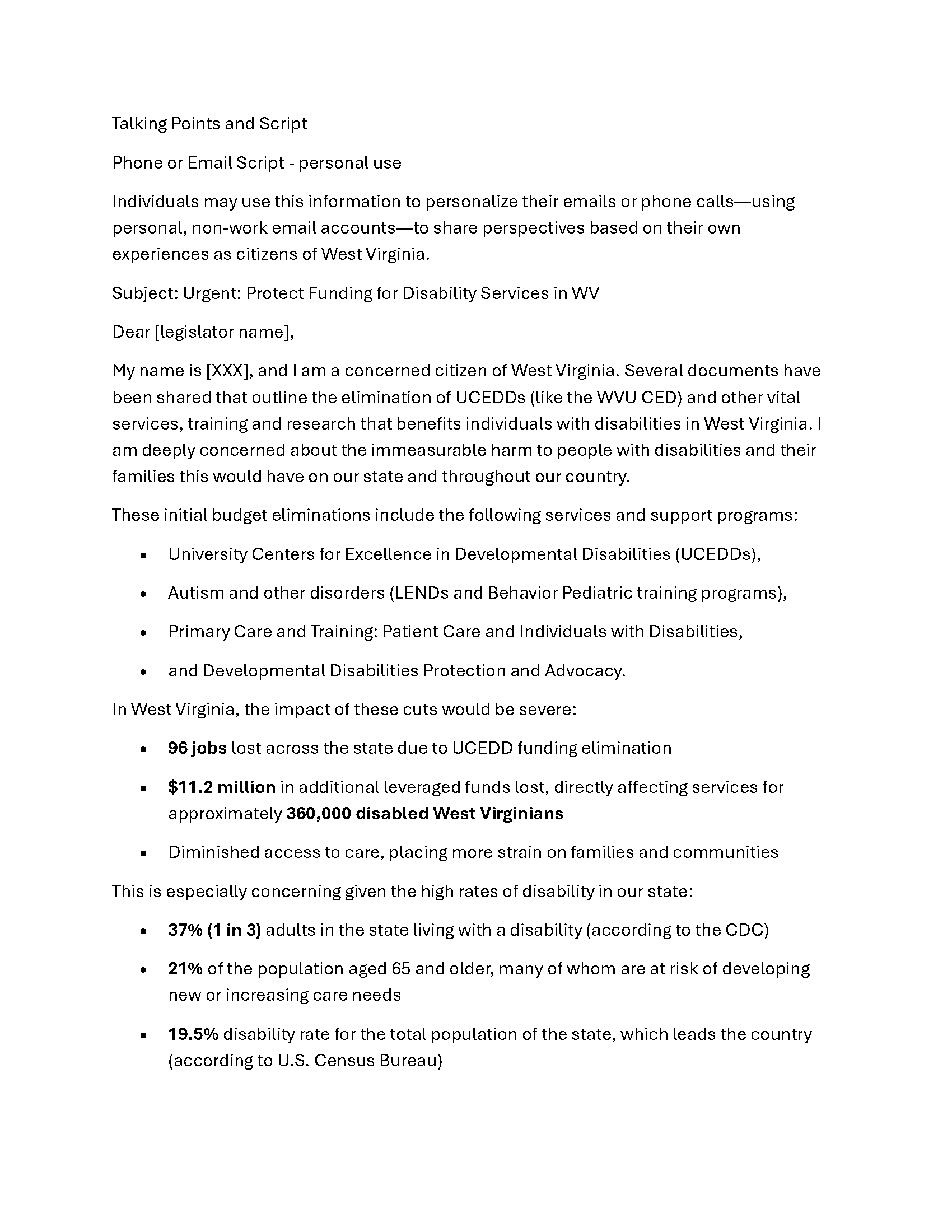
Download a Word Document of this Script Download a PDF of this scriptIndividuals may use this information to personalize their emails or phone calls—using personal, non-work email accounts—to share perspectives based on their own experiences as citizens of West Virginia.
Subject: Urgent: Protect Funding for Disability Services in WV
Dear [legislator name],
My name is [XXX], and I am a concerned citizen of West Virginia. Several documents have been shared that outline the elimination of UCEDDs (like the WVU CED) and other vital services, training and research that benefits individuals with disabilities in West Virginia. I am deeply concerned about the immeasurable harm to people with disabilities and their families this would have on our state and throughout our country.
These initial budget eliminations include the following services and support programs:
- University Centers for Excellence in Developmental Disabilities (UCEDDs),
- Autism and other disorders (LENDs and Behavior Pediatric training programs),
- Primary Care and Training: Patient Care and Individuals with Disabilities,
- and Developmental Disabilities Protection and Advocacy.
In West Virginia, the impact of these cuts would be severe:
- 96 jobs lost across the state due to UCEDD funding elimination
- $11.2 million in additional leveraged funds lost, directly affecting services for approximately 360,000 disabled West Virginians
- Diminished access to care, placing more strain on families and communities
This is especially concerning given the high rates of disability in our state:
- 37% (1 in 3) adults in the state living with a disability (according to the CDC)
- 21% of the population aged 65 and older, many of whom are at risk of developing new or increasing care needs
- 19.5% disability rate for the total population of the state, which leads the country (according to U.S. Census Bureau)
The WVU CED provides vital programs that support individuals across their lifespan, including aging adults with disabilities. The national Developmental Disability Network, made up of UCEDDs, and Protection and Advocacy Systems (P&As), has been improving the lives of individuals with disabilities for nearly 50 years.
If these programs are eliminated, individuals with disabilities, their families, and community providers will lose access to essential research, services, and training.
I urge you to consider the tremendous impact these cuts would have on West Virginians. Thank you for your attention to this critical issue.
Sincerely,
[Your Name]
[Your Address]
[Your Contact Information] -
Sample Save Disability Rights of West Virginia Script
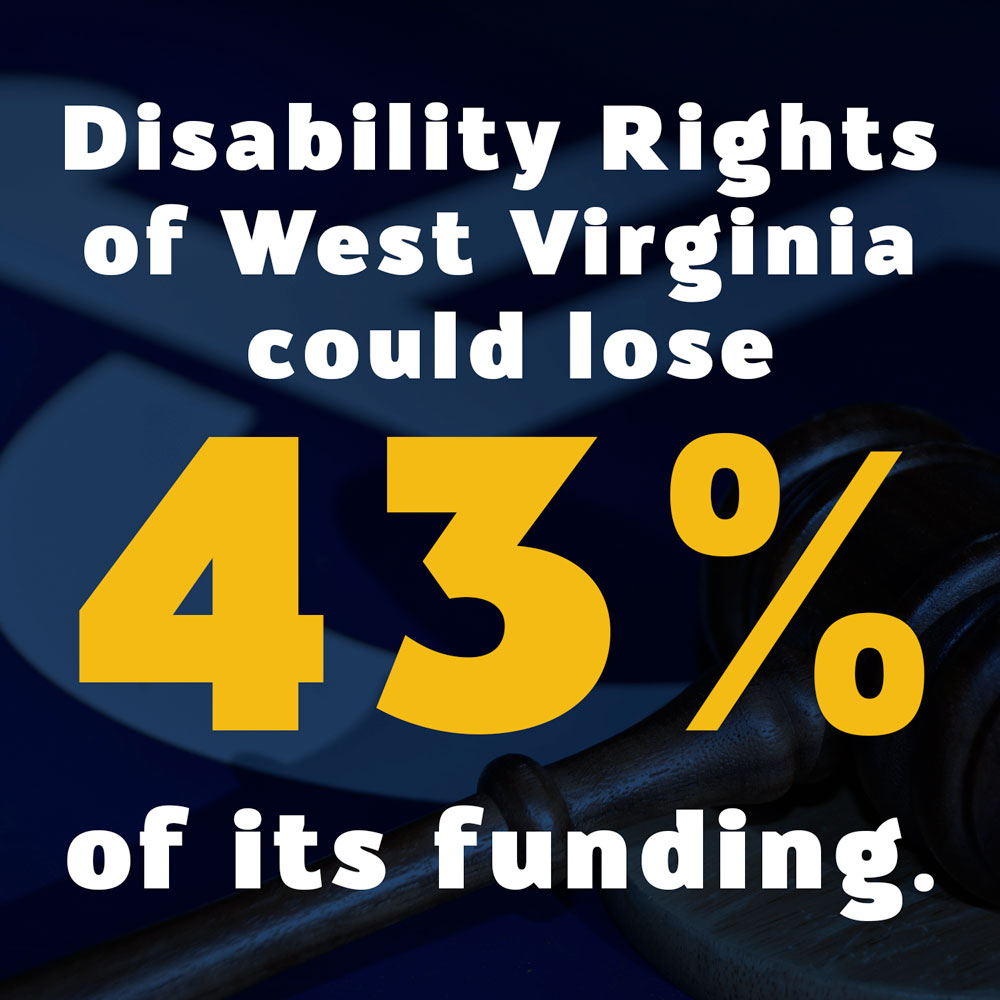
Download a Word Document of this Script Download a PDF of this scriptThe proposed 43% cut to Disability Rights of West Virginia (DRWV)'s protection and advocacy funding would have a significant and immediate impact on a state that already faces unique challenges regarding its disability population.
Below is a sample letter/email that can be used by Disability Rights of WV and their partners to contact legislators if they so choose.
Subject: Urgent: Protect Protection and Advocacy Funding for West Virginians with Disabilities
Dear [Legislator's Name],
I am writing to express my serious concern regarding the proposed reductions in funding for vital programs serving individuals with disabilities in West Virginia, including the Protection and Advocacy for Individuals with Disabilities (PAIR), Protection and Advocacy for Individuals with Mental Illness (PAIMI), Protection and Advocacy for the Help America Vote Act (PAVA), and the Client Assistance Program (CAP).
Adding to these concerns are the proposed cuts to University Centers for Excellence in Developmental Disabilities (UCEDDs), such as the WVU CED. These combined reductions threaten to significantly diminish the services, advocacy, and representation available to our disability community.
West Virginia is a small state with the highest per capita rate of individuals with disabilities in the nation—one in three residents. We already face unique challenges in ensuring access, protection, and support for these individuals. The collective impact of cutting both protection and advocacy funding and UCEDD resources would be a devastating blow to our capacity to serve and advocate for this vulnerable population.
This is a critical time to support, not diminish, our efforts to provide accessible healthcare, housing, voting rights, and safeguards against abuse and neglect. The proposed cuts threaten to weaken our safety net and reduce the voices of individuals with disabilities in our state.
I strongly urge you to oppose these reductions and support maintaining or increasing funding for these essential programs. Protecting the rights and well-being of people with disabilities in West Virginia is not only a moral obligation but vital for our community’s strength and inclusiveness.
Thank you for your attention to this urgent matter. I am happy to discuss further or provide additional information.
Sincerely,
[Your Name]
-
-
-
Download a Word Document of this Script Download a PDF of this script
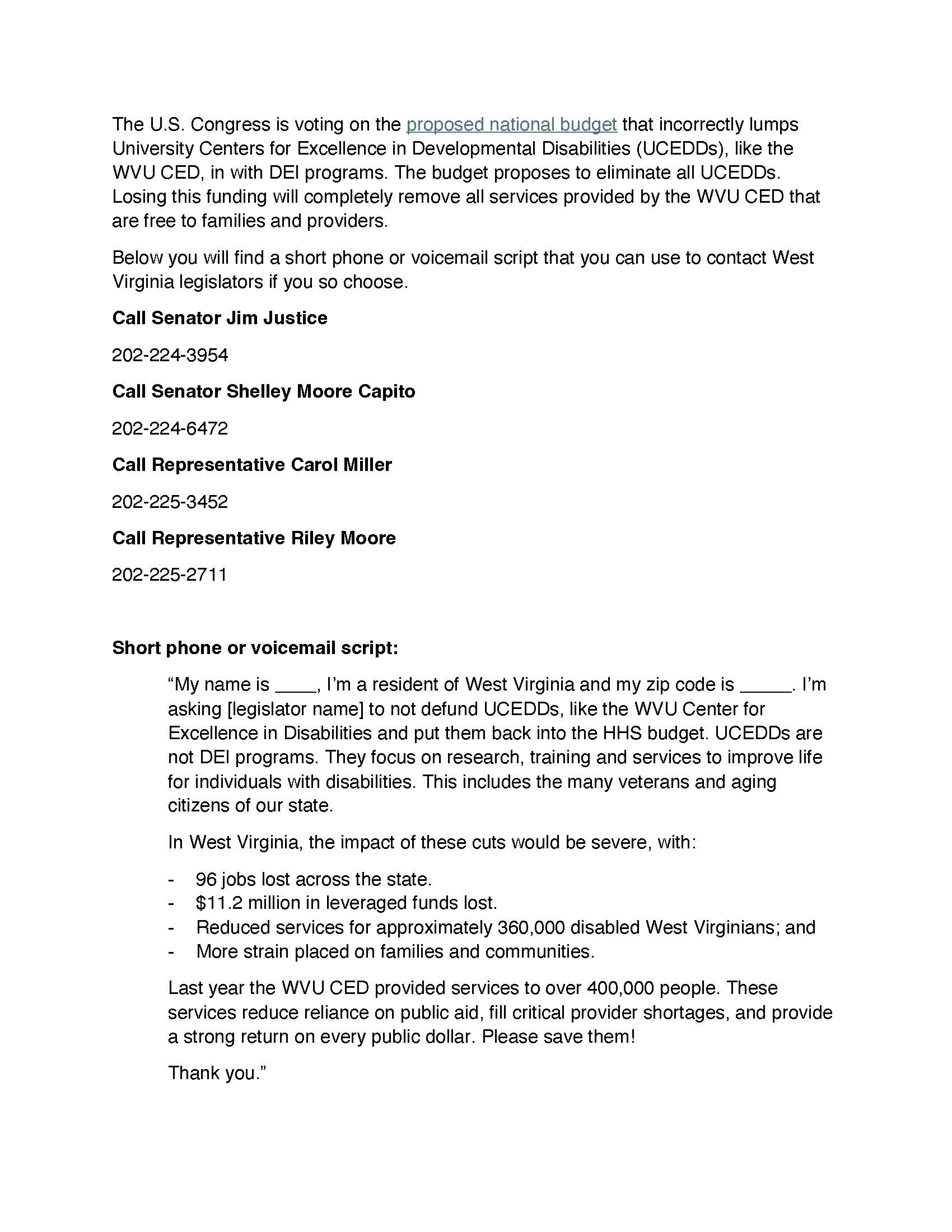
The U.S. Congress is voting on the proposed national budget that incorrectly lumps University Centers for Excellence in Developmental Disabilities (UCEDDs), like the WVU CED, in with DEI programs. The budget proposes to eliminate all UCEDDs. Losing this funding will completely remove all services provided by the WVU CED that are free to families and providers.
Below you will find a short phone or voicemail script that you can use to contact West Virginia legislators if you so choose.
- Call Senator Jim Justice: 202-224-3954
- Call Senator Shelley Moore Capito: 202-224-6472
- Call Representative Carol Miller: 202-225-3452
- Call Representative Riley Moore: 202-225-2711
Short phone or voicemail script:
“My name is ____, I’m a resident of West Virginia and my zip code is _____. I’m asking [legislator name] to not defund UCEDDs, like the WVU Center for Excellence in Disabilities, and put them back into the HHS budget. UCEDDs are not DEI programs. They focus on research, training, and services to improve life for individuals with disabilities. This includes the many veterans and aging citizens of our state.
In West Virginia, the impact of these cuts would be severe, with:
- 96 jobs lost across the state.
- $11.2 million in leveraged funds lost.
- Reduced services for approximately 360,000 disabled West Virginians; and
- More strain placed on families and communities.
Last year the WVU CED provided services to over 400,000 people. These services reduce reliance on public aid, fill critical provider shortages, and provide a strong return on every public dollar. Please save them!
Thank you.” -
Sample Save Disability Rights West Virginia Phone or Voicemail Script
Download a Word Document of this Script Download a PDF of this scriptThe proposed 43% cut to Disability Rights of West Virginia (DRWV)'s protection and advocacy funding would have a significant and immediate impact on a state that already faces unique challenges regarding its disability population.
Below you will find a short phone or voicemail script that you can use to contact West Virginia legislators if you so choose.
- Call Senator Jim Justice: 202-224-3954
- Call Senator Shelley Moore Capito: 202-224-6472
- Call Representative Carol Miller: 202-225-3452
- Call Representative Riley Moore: 202-225-2711
Short phone or voicemail script:
“Hello, my name is [Your Name], and I’m a resident of [City/Town]. I’m calling to express my concern about the proposed cuts to funding for the Protection and Advocacy programs in West Virginia, including PAIR, PAIMI, PAVA, and CAP.
These programs are vital for protecting the rights and safety of our most vulnerable residents. Additionally, with proposed cuts to the University Centers for Excellence in Developmental Disabilities, like the WVU CED, these combined reductions would significantly disrupt essential services for individuals with disabilities across the state.
A loss of funding would impact access to healthcare, housing, voting rights, and protection from abuse or neglect. I strongly urge you to oppose these cuts and support maintaining or increasing funding for these programs.
Thank you for your time and for advocating for the well-being of West Virginia’s residents with disabilities.”
-
-
-
Our friends, family and neighbors with disabilities deserve dignity and to receive services where and when they choose. Services at the WVU CED help West Virginians with disabilities be as independent as possible and participate in their communities. The U.S. President’s proposed budget would eliminate the WVU CED and all University Centers for Excellence in Developmental Disabilities (UCEDDs) in the country. #SaveUCEDDs
-
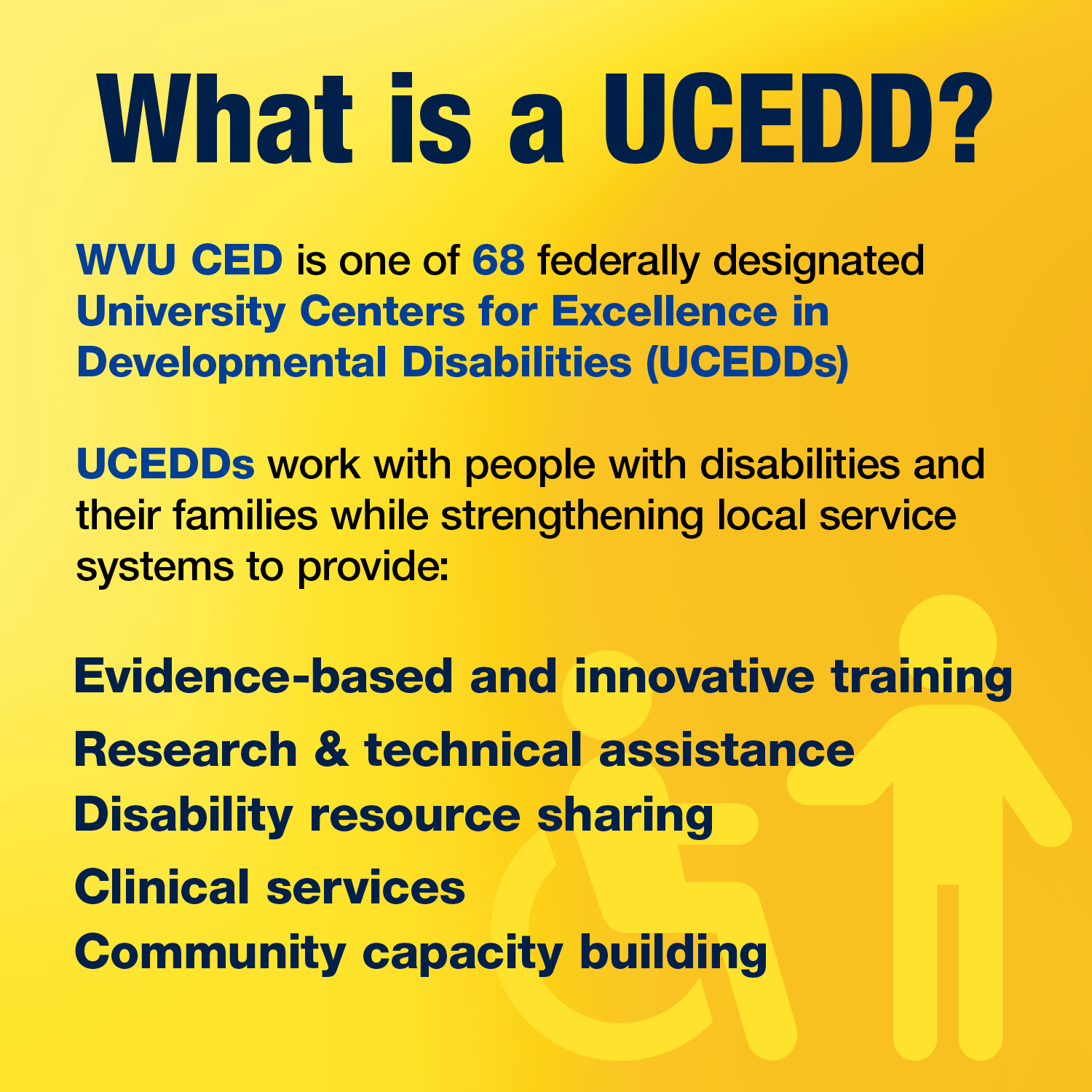
What is a UCEDD? University Centers for Excellence in Developmental Disabilities like the WVU CED work with people with disabilities, members of their families, state and local government agencies, and community providers in projects that provide evidence-based and innovative training, technical assistance, clinical service, research, and information sharing, with a focus on helping people with disabilities participate fully in their communities. All UCEDDs including the WVU CED would be eliminated if the U.S. President’s new proposed budget is accepted. #SaveUCEDDs
-
According to U.S. Census Bureau data, 19.5% of the state’s population has a disability. The WVU CED has 20 programs that provided 6,395 free clinical services and trained over 15,000 people last year. All of these free services and trainings would be lost if the administration’s proposed budget passes, which would eliminate all University Centers for Excellence in Developmental Disabilities (UCEDDs) in the country. #SaveUCEDDs
-
The U.S. President’s budget proposes cuts to the funding for the WVU CED. If that funding is removed, 96 people will lose their jobs throughout the state, $11.2 million additional leveraged dollars will be lost removing direct services to an average of 360,000 West Virginians with disabilities. #SaveUCEDDs
-
Our programs help children with communication disorders interact with the world by using augmentative and alternative communication (AAC) devices, connect adults and children with developmental disabilities to loving foster families, offer support and resources for mothers with children born exposed to substances in utero, help individuals with traumatic brain injury (TBI) find connection and resources in multiple support groups, loan out thousands of assistive technology (AT) devices to people with and without disabilities for free, and so much more. If the administration’s proposed budget is accepted, all of these services will be eliminated. #SaveUCEDDs
-
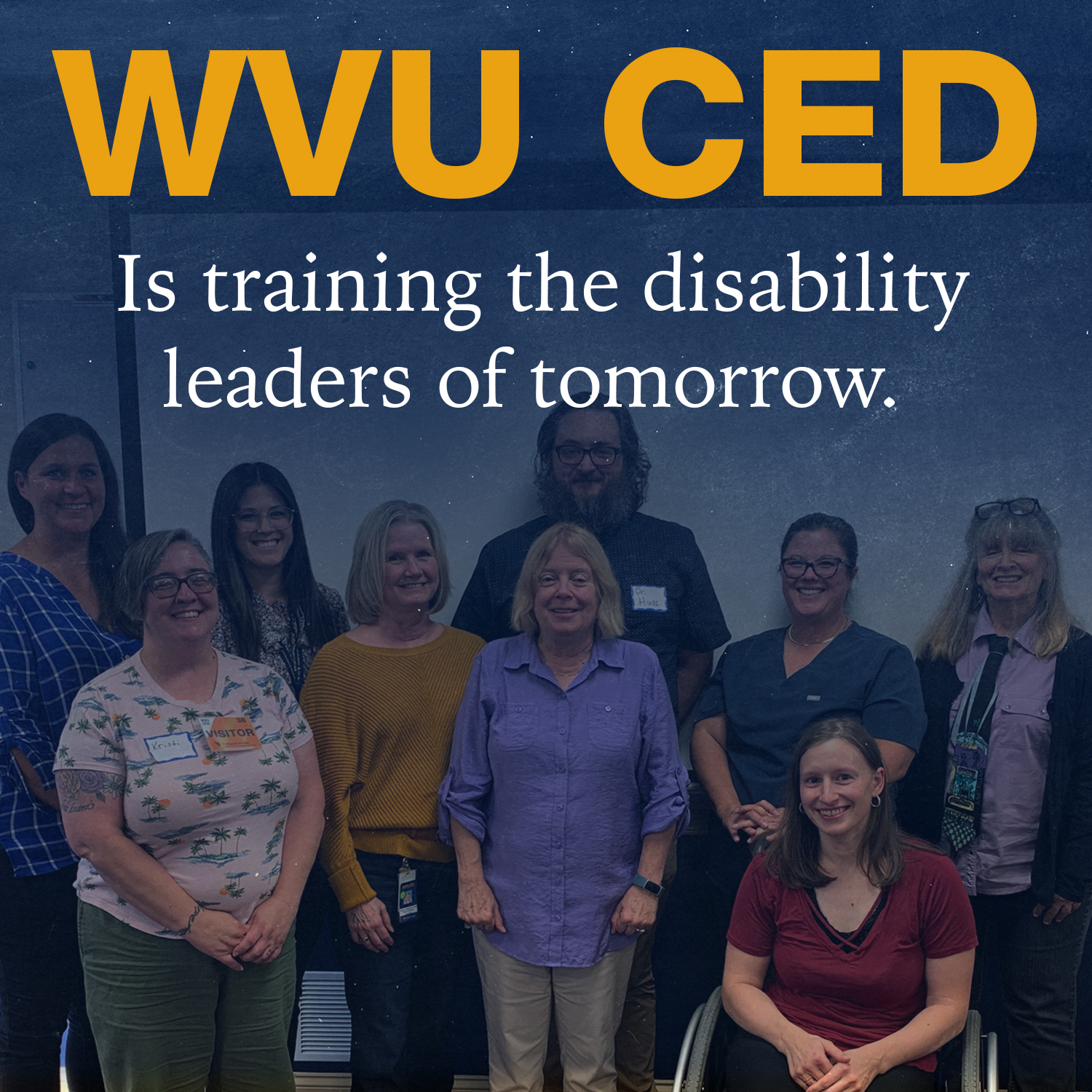
WVU CED trainees are making a difference in rural communities. The WV LEND program prepares students, self-advocates, community members and families to be leaders in disability education, research and advocacy. WV LEND and the WVU CED are part of the University Centers for Excellence in Developmental Disabilities (UCEDDs) which will be eliminated under the administration’s proposed budget. #SaveUCEDDs
-
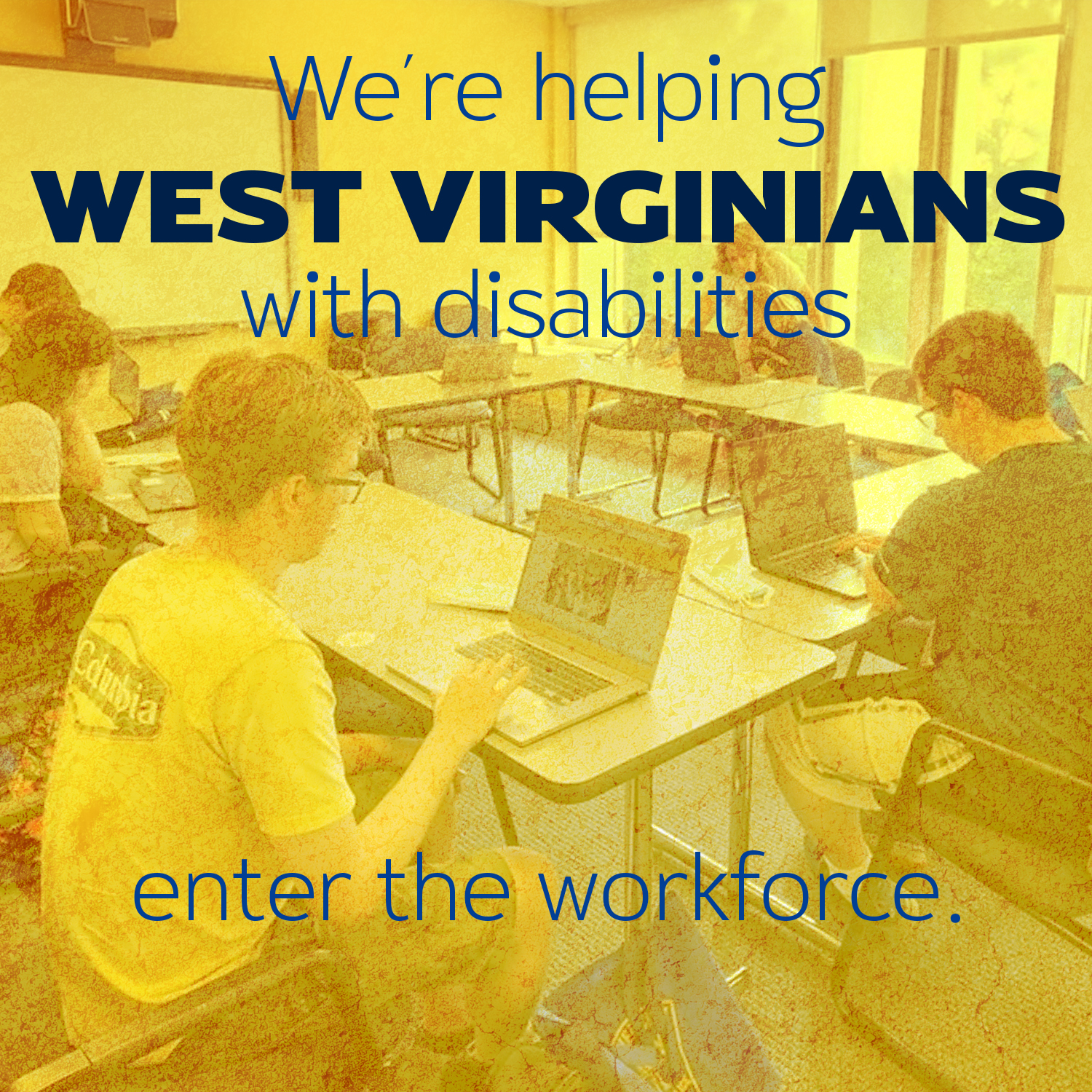
Disability Employment Services at the WVU CED help West Virginians with disabilities find meaningful employment. We help them make resumes, practice interviews and receive training. This program also provides technical assistance to employers on disability-related labor issues. All University Centers for Excellence in Developmental Disabilities (UCEDDs) including the WVU CED are set to be eliminated if the administration’s proposed budget is accepted. #SaveUCEDDs
-
The WVU CED and many of our state partners would all be eliminated under the U.S. President’s new proposed budget. Combined, these agencies provide vital services and advocacy for West Virginians and their families. #SaveUCEDDs
-
Did you know that University Centers for Excellence in Developmental Disabilities (UCEDDs) like the WVU CED focus specifically on research, training and services to improve the lives of individuals with disabilities?
In contrast, DEI (Diversity, Equity, and Inclusion) efforts aim to promote fairness and representation across all groups. The new federal budget incorrectly lumps UCEDDs in with DEI programs and proposes that all UCEDDs be eliminated.
While both are vital, UCEDDs are specialized in disability-related expertise and are funded through dedicated programs, separate from broader DEI initiatives or federal budget allocations. Let's recognize their unique role! #SaveUCEDDs
-
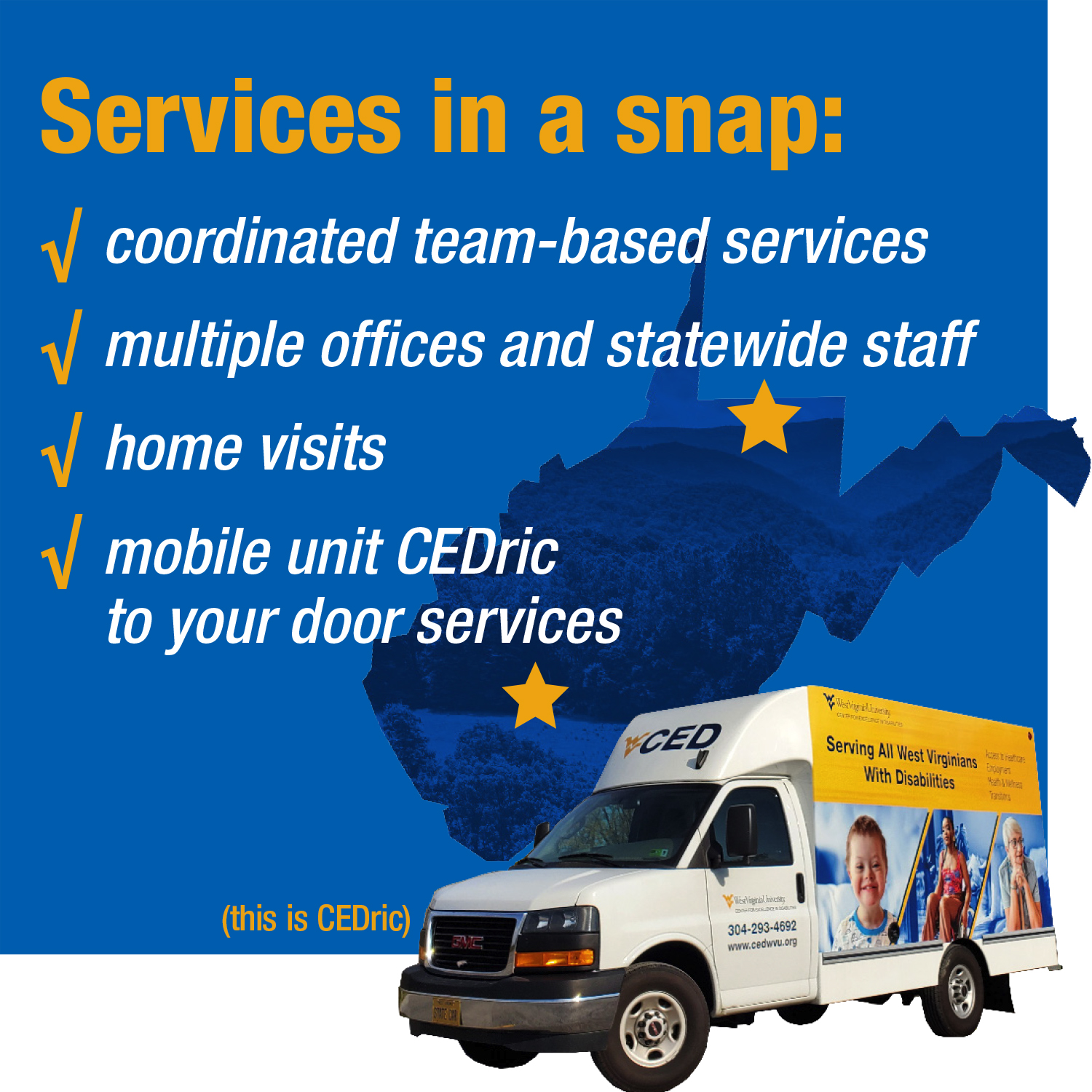
The WVU CED has over 20 programs and clinics that provide free services to West Virginians with disabilities, families, caregivers and professionals. CED services include direct support, resource coordination, multiple training offerings and more.
While the main offices are in Morgantown and Charleston, CED staff are located in multiple counties throughout the state, providing boots-on-the-ground support for families with disabilities living in rural areas. The CED’s box truck “CEDric” allows us to deliver assistive technology equipment, transport educational materials, and engage with the community at various resource fairs and events all across the state.
The new federal budget incorrectly lumps University Centers for Excellence in Developmental Disabilities (UCEDDs) like the WVU CED in with DEI programs. If the new budget is passed, the WVU CED will be eliminated along with every other UCEDD in the country. #SaveUCEDDs
-
WVU CED programs provide peer-to-peer support to families who have children with special healthcare needs, multidisciplinary feeding assessments for children who are experiencing feeding difficulties, mental health services for individuals with disabilities and their families, Positive Behavior Support services to improve quality of life and decrease challenging behaviors, training and resources for at-risk youth and young adults ages 14-25, and so much more.
The new federal budget incorrectly lumps University Centers for Excellence in Developmental Disabilities (UCEDDs) like the WVU CED in with DEI programs. If the new budget is accepted, the WVU CED and its programs will face elimination. #SaveUCEDDs
-
Disability Rights of West Virginia (DRWV), the organization in West Virginia that works to protect the right s of people with disabilities, may lose 43% of its funding if changes are not made to the proposed federal budget.
This Protect Disability Network Digital Toolkit includes sample email and phone scripts that mention Protection & Advocacy programs like DRWV. You can further customize these messages to focus on DRWV programs that are important to you and reach out to representatives if you so choose. The kit also includes shareable social media graphics, key facts, and more.
View the toolkit: https://cedwvu.org/protect-disability-network-digital-toolkit/
-
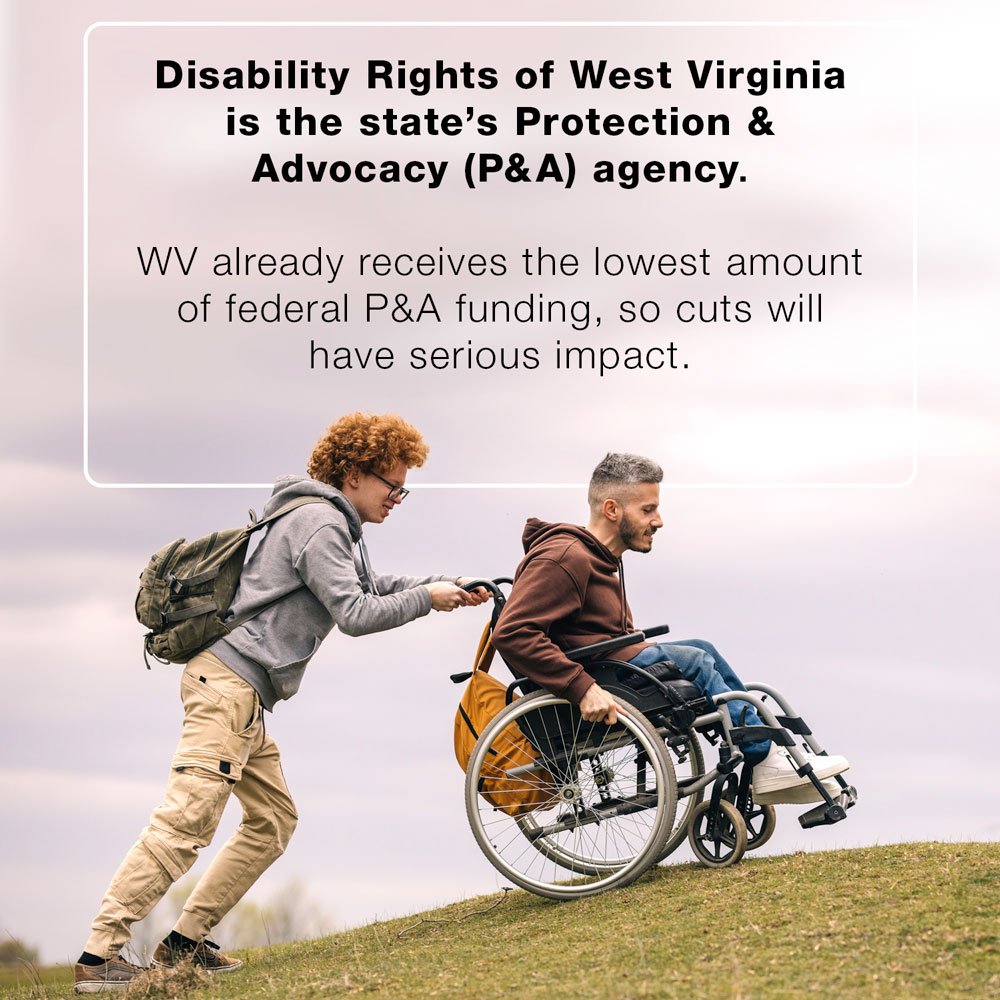
Disability Rights of West Virginia (DRWV) works to protect the rights of people with disabilities as the state’s Protection & Advocacy (P&A) system. The proposed federal budget will make large cuts to DRWV and other P&A programs if it goes through unchanged. West Virginia already receives the lowest level of federal funding for P&A programs compared to states with larger populations. This means that any cuts, especially one this big, will have a serious impact.
This Protect Disability Network Digital Toolkit includes sample email and phone scripts that mention Protection & Advocacy programs like DRWV. You can further customize these messages to focus on DRWV programs that are important to you and reach out to representatives if you so choose. The kit also includes shareable social media graphics, key facts, and more.
View the toolkit: https://cedwvu.org/protect-disability-network-digital-toolkit/
-
The proposed federal budget will make large cuts to Disability Rights of West Virginia (DRWV) and other Protection & Advocacy (P&A) programs if it goes through unchanged.
Cutting funding for P&A programs in a state like West Virginia, where the rate of disability is the highest in the country and funding is already low, will seriously weaken systems for a highly vulnerable population and could have dire consequences for their safety, independence, and overall quality of life.
This Protect Disability Network Digital Toolkit includes sample email and phone scripts that mention Protection & Advocacy programs like DRWV. You can further customize these messages to focus on DRWV programs that are important to you and reach out to representatives if you so choose. The kit also includes shareable social media graphics, key facts, and more.
View the toolkit: https://cedwvu.org/protect-disability-network-digital-toolkit/
-
-
- Senator James C. Justice II
G12 Dirksen Senate Office Building
Washington, DC 20510
Phone: 202-224-3954
https://www.justice.senate.gov/
Jim Justice contact form - Senator Shelley Moore Capito
172 Russell Senate Office Building
Washington, DC 20510
Phone: 202-224-6472
www.capito.senate.gov
Shelley Moore Capito contact form - Congresswoman Carol Miller
1605 Longworth House Office Building
Washington, DC 20515
Phone: 202-225-3452
https://miller.house.gov
Carol Miller contact form - Congressman Riley Moore
1337 Longworth House Office Building
Washington, DC 20515
Phone: 202-225-2711
https://rileymoore.house.gov/
Riley Moore contact form
- Senator James C. Justice II